Advanced vehicle rules
Introduction
Most players should start with the standard vehicle rules and only try the more advanced version below if their goals are not met.
This is a set of optional rules for Down Range that give more depth to vehicle combat. Originally developed at the request of a unit that wanted to support their armor school with more specific wargaming, this module is broad enough for players to integrate into their games even if they're not trying to run a training pipeline for tankers.
You don't need these rules to include vehicles in your Down Range scenarios, and using them will add complexity, bookkeeping, and some extra annoyance to players' experience. Using this module is recommended only if your goals in playing Down Range include the following:
- Training for armored warfare and counter-armor tactics where degrading or disabling specific vehicle systems is a key focus
- Indulging in masochism and/or simply an unnatural fondness for more dice, more recordkeeping, and more numbers
Treat these rules as an a la carte menu of additional mechanics. Use only the ones you find useful to your reason for playing Down Range, and ignore the others. There is no difference between base Down Range units and those using the advanced vehicle rules; all the cards and miniatures you have for the base game still work perfectly.
A print version of just these additional rules is available as a PDF.
Vehicle systems
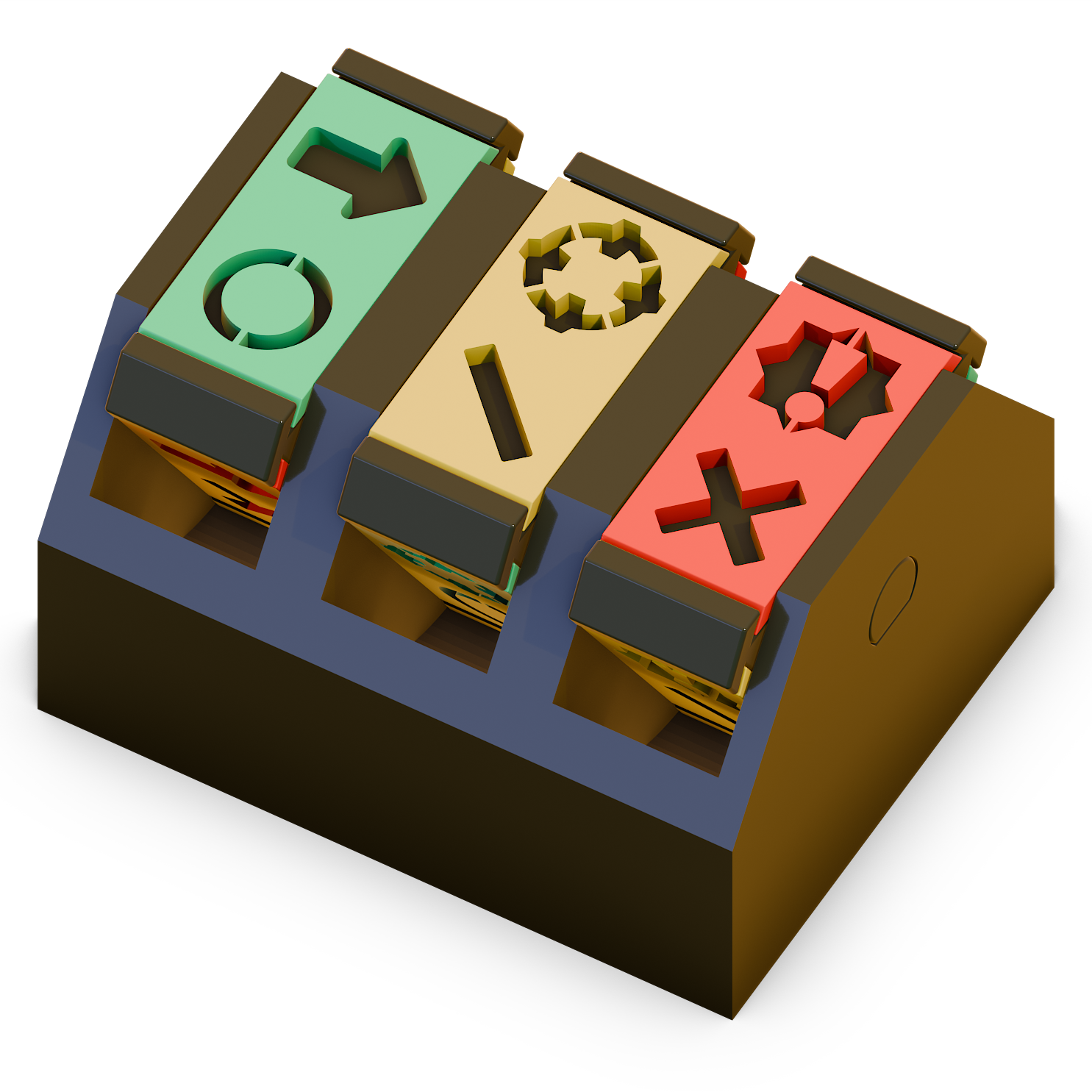
The biggest change from the basic Down Range rules that vehicles are no longer treated as monolithic entities that are either fully in the fight or downed completely. Instead, each vehicle is split into three systems, each of which can either be:
-
 Operational
 Degraded,
-
 Disabled
The three systems for vehicles are  mobility,
  firepower, and
  control. A complete table of vehicle statuses per system is provided below.
These systems can be either attacked individually, or be damaged as part of a holistic attack on the vehicle.
Mobility
The mobility of a vehicle represents is ability to  move. It's the sum of all the wheels, tracks, rotors, etc. as well as the power plant and drive train of a vehicle.
| Mobility | |
|---|---|
| Status | Effect |
| Operational | The vehicle can use its full move. |
| Degraded | The vehicle's The vehicle can no longer move through difficult terrain at all, if that terrain would cut its movement in half under the ordinary rules. |
| Disabled | The vehicle can no longer move at all. |
Firepower
The firepower of a vehicle represents its ability to effectively use its weapons systems. This includes everything from the weapons themselves to fire control systems and the crew's ability to use both. This includes any  EW systems the vehicle has.
| Firepower | |
|---|---|
| Status | Effect |
| Operational | The vehicle makes attacks as normal. |
| Degraded | The vehicle makes all attacks at a  disadvantage. disadvantage. |
| Disabled | The vehicle can't make any attacks at all, to include the use of any EW systems. |
Control
The control of a vehicle represents the ability of the crew to coordinate everything effectively. It's more abstract than the other two, but generally can be thought of as the sum of the crew's morale, communication systems, and the integration of all the technical systems.
| Control | |
|---|---|
| Status | Effect |
| Operational | The vehicle operates normally. |
| Degraded | All communication is limited to the vehicle's It can't benefit from being the Any |
| Disabled | The vehicle can no longer communicate at all or use any It can't benefit from being the The vehicle makes all actions at a |
Damaging vehicles
Holistic damage
For normal attacks not targeting a specific vehicle system, conduct attacks as per the normal rules.
Once  damage is rolled, compare it to the result of the
  defense roll and do the following:
- If the damage is less than the defense, nothing happens.
- If the damage is equal to or greater than the defense, set one system of the attacker's choice one step down, whether from operational to degraded or from degraded to disabled.
- If the damage is twice as much as the defense, the attacker now has two steps to use. They can set an operational system to disabled, set two operational systems to #("degraded"), and so on.
- If the damage is three times as much, the attacker has three steps to play with, and so on.
If all three systems are disabled, the vehicle as a whole is destroyed and any crew inside are killed.
Holistic damage example
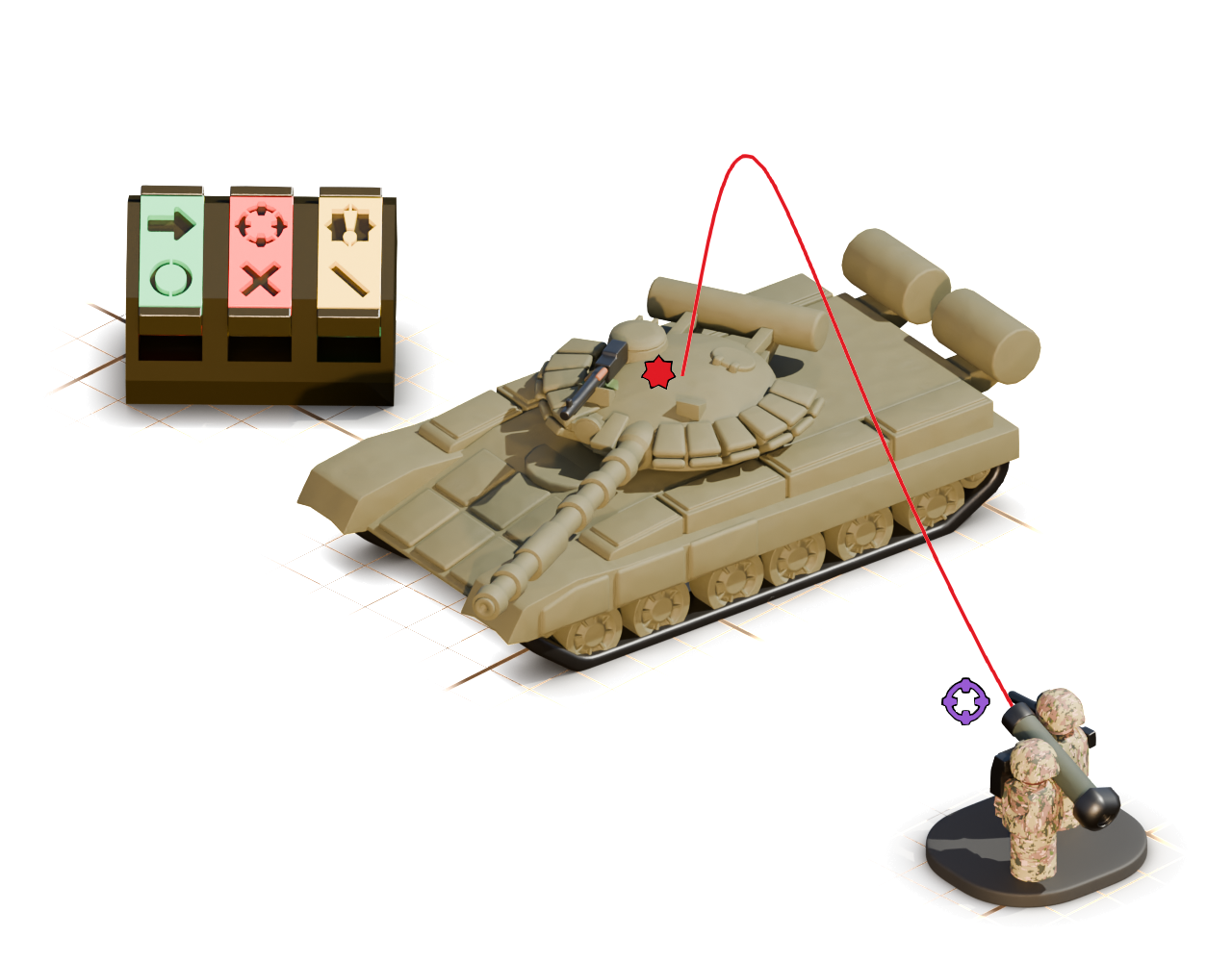
Chuck's Javelin team has landed a shot with against David's T-80, which is currently fully-operational. The Javelin has a damage of  +3, and the T-80 has a defense of .
Chuck rolls the damage and gets an 8 and a 9, for a total of 20 damage. David rolls a 4, a 2, and a 1 for his defense, for a total of 6. 20 / 6 = 3.33..., so Chuck has three steps of damage to play with. He decides to reduce the T-80's firepower two steps, rendering it disabled, and reduces the T-80's control one step, rendering it degraded.
Targeting systems
Sometimes, vehicle systems can be attacked individually. The tires of a truck can be shot at from close range; sensor systems on a tank can be targeted by drones, and so on.
Players should exercise their judgment on what can be reasonably targeted, considering factors like how precise the weapon system is to begin with, how close the attacker is, and whether the damage can feasibly be concentrated on a single system. It's probably pretty hard to attach a bicycle with a hand grenade and only hit the wheels, but attacking the propulsion of a ship with naval gunfire and leaving everything else intact is a lot more doable.
These attacks are executed as per the normal Down Range rules, with two changes:
- Due to the difficulty of hitting a specific part of a vehicle, all attacks to specific vehicle systems are made at a disadvantage. (Remember that if there's something else that grants an
 advantage on the same attack, these cancel each other out.)
 - The usual rule about needing a weapon whose damage uses a dice type at least as big as the target's defense does not apply. A rifle doing
 damage can be used to attack the optics with a tank whose defense is , for example, damaging its control.
The specific system being targeted needs to be visible as per the normal rules, too; for example, a tank in a ditch may not be able to have its mobility targeted due to the ground providing cover to its tracks.
If the attack hits, the rules for damage are the same as for holistic damage above, but limited to the specific system being attacked.
Targeting systems example
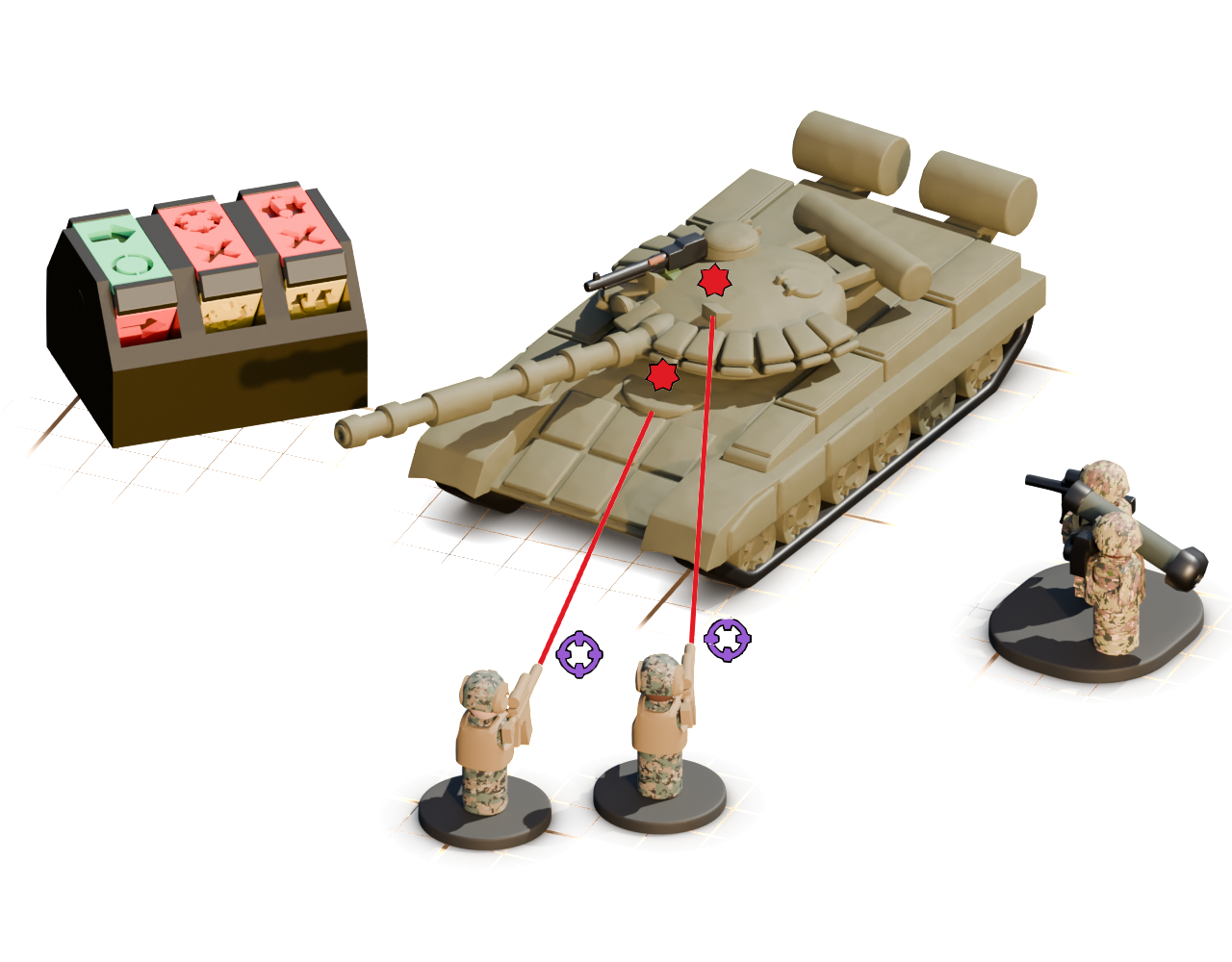
With David's T-80 rendered unable to fire and its sensors damaged by Chuck's Javelin team, Eric sends his infantrymen in. The four of them have M27 rifles, which do damage. With their fire concentrated on the T-80's periscopes and cameras, three of them hit, getting a 6, a 4, and a 3 respectively.
Whether due to poor maintenance or simply bad luck, David's T-80 comes up with another roll of 6 for its defense, meaning that one of the rifle shots hits. Due to the targeting of the cameras and periscopes, the resulting effects knock the T-80's control down one more step, rendering the control system completely disabled.
At this point, the T-80 can no longer communicate or attack, can't benefit from  main effort designation, and makes all actions at a disadvantage. Any further attacks against it will be made with an advantage.
Targeting crew
Targeting specific crew members of a vehicle is conducted identically to the normal Down Range rules. The attacker must be able to hit the crew or passengers directly using the intended weapon system, and the attack is made at a disadvantage. A tank commander standing in an open hatch or a truck driver visible through the windshield in an unarmored commercial truck can be targeted directly with rifle fire, for example. The driver of a buttoned-up tank or passengers in the back of a descending helicopter can't.
Targeting crew example
On David's turn, he decides that his T-80 is unlikely to survive another round, and decides to have the tank commander and gunner open their hatches and engage the Javelin team with their pistols. The players agree this is plausible and allow it.
However, Chuck has kept a C6 medium machine gun team ready with a  reaction. The gun's
  fan is 4, and Chuck allocates two shots to each enemy crewman. Since the attack is made at a disadvantage, only one shot each hits. However, the damage of
  is enough to produce a 6 and a 5 against the enemy crew's defense of 4, and the T-80 turret's interior is handily redecorated with the splattered remnants of its erstwhile operators.
Players should exercise their judgment on what constitutes visibility. Unless Down Range is being played with models that have individual crew, opening hatches, etc., this is a question that requires some imagination. A good rule of thumb is that if the defending player is using crew members to take actions that would require them to be visible from outside (e.g. shooting through an open window), they're visible.
Vehicle recovery
A vehicle specifically designed to recover other armored vehicles can be used to pull even destroyed vehicles out of harm's way.
A recovery vehicle must spend one full turn completely stationary next to the vehicle it's recovering to attach the appropriate equipment. The recovery vehicle or its crew can take no other actions on that turn. Any passengers are free to act as normal.
Once the recovery equipment is in place, the recovery vehicle moves at half its usual move, rounded down, and moves the downed vehicle with it. Players should determine the position of the downed vehicle with common sense based on the design of the recovery vehicle. If the recovery vehicle tows things, for example, put the downed vehicle behind the recovery vehicle model.
Downed vehicles can be used as cover, and nothing stops players from using recovery vehicles to move other things so long as they agree on what's plausible for their game scenario.
Improvised recovery
Vehicles that are not designed as recovery vehicles can try to push other vehicles out of the way. The target vehicle must be friendly; otherwise, treat it as a vehicle crash per the base rules.
The pushing unit must have a defense with at least the same number and type of dice as the target. For example, a truck with a defense of cannot push a tank with , and neither can an armored vehicle with a defense of just .
The pushing unit can use all of its move on a turn to push the other unit up to 8" or the pushing vehicle's move, whichever is less. The movement must be in a straight line.
Only one vehicle can push a given other vehicle in a round.
Vehicle repair
When using the advanced vehicle rules, repairs are handled differently from the base Down Range game.
Units with a specialty for mechanics and the appropriate tools can  focus on their turn, sacrificing their movement and using their action to attempt to repair a single vehicle system.
The repair attempted must be plausible given the situation in the game, taking into account the tools and repair parts available. For example, a tank with a broken track can be repaired if spare links are available, a gun truck can have its firepower restored if another gun can be salvaged from a downed vehicle, and a vehicle with a malfunctioning computer system can be fixed with a sufficiently capable software expert.
To execute the repair, the specialist picks the system they want to repair and rolls their specialty  skill of , applying any advantages and disadvantages or extra +1 values from adjacent mechanic units focusing to assist. (Common disadvantages include working on a moving vehicle or being suppressed by enemy fire.)
- If the system is disabled, the
 difficulty is 7.
 - If the system is degraded, the difficulty is 5.
On a success, the vehicle system's status improves by one step: disabled systems become degraded, and degraded systems become fully operational again.
A given vehicle can only have one step worth of repair performed on it per turn, regardless of how many mechanics are available.